


How ChatGPT and AI Tools Are Changing Everyday Jobs in 2026
Just this year, more than 100,000 tech workers worldwide have been laid off across companies like Amazon, Intel, Microsoft, Meta, IBM, and Salesforce.
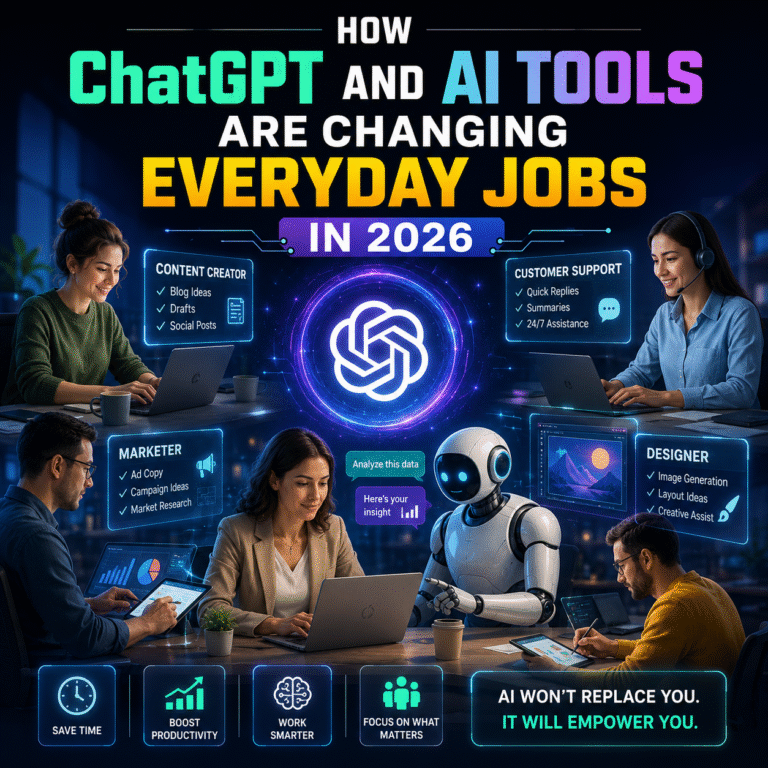
What is in it for you?
- Asymmetric impact of AI
- How are we seeing AI in the workplace?
- Vulnerability of job to AI
- Is AI capable enough to improve jobs?
- What you can do right now to make your career as “AI proof” as possible
Amazon alone cut 14,000 corporate roles. Klarna reduced its staff by nearly 40% as it leaned into guess what? AI. Duolingo is phasing out human contractors in favor of automation. And this isn’t limited to tech. In the UK, one in six employers now expect AI to reduce their workforce in the next year with junior roles hit first.
AI, political turbulence, and economic pressure together have created what some people are already calling the job-pocalypse. Here’s the paradox, companies are publicly admitting that, “If we don’t adopt AI, we won’t exist in 15 years.” And at the same time, they’re hiring fewer juniors than ever. It really feels like this first step of the career ladder is cracking and if that first step is gone, what does that mean for future work of the careers of recent graduates?
Maybe the terrifying truth of 2026 is that we are raising a generation of professionals who will never be able to gain the experience required to lead, is it?
Asymmetric impact of AI
Let us evaluate the winners of 2026, 2026 winners, the roles deleted and the new norms for surviving the professional divide.
Source – Harvard Business School
- Seniority roles exposure : The data from 2025-2026 have highlighted that senior roles are still growing while junior roles have plummeted by 16% in the AI economy. Companies today are choosing to pay one AI augmented senior rather than 3 juniors because the senior has the judgment and a higher level of thinking to fact check the machine quickly and more efficiently.
- White collar VS blue collar : Paradoxically. The safest jobs in 2026 are no more into the. Field of coding or law? They are in plumbing, nursing and electrical work. You understand this fact that AI can draft a legal brief in seconds, but it cannot fix the burst pipe. Do you agree?
Fairly the knowledge economy is shrinking, as we can all see, while the physical economy is holding its ground.
- The gender gap : Women dominated roles in administration, customer service and healthcare support are seeing nearly double the automation risk compared to male dominated manual labor.
What is the survivor’s strategy here?
- No AI tool will ever be able to beat human judgment. So train yourself and build a workflow that generates responses using AI then layer it with your human judgment. Companies do not need another pair of, hence they need someone who can build a system that creates output 10 times faster.
- If you are someone who is owning a degree Or say you have an experience in any entry level job is something which can easily be overlooked. Your new resume is your living, breathing portfolio of problems you have solved using AI.
- Human in the loop now and always will remain at centre. AI will hallucinate and mess up the context, the intent, the need and the solution as a whole. You’re editor in chief. You are someone who understands emotion. You are someone who understands grief. You are someone who is in the position of yourself as the person who validates or applies an expertise to AI, you make yourself indispensable and give it back to machines.
How are we seeing AI in the workplace?
In 2026, AI has become omnipresent. Today you are not chatting with AI, you are looking at autonomous agents that have their own logins, multi model workflows where a meeting is transcribed, summarized and turned into a project plan in seconds. Looking at the instances employees are secretly using advanced models to stay ahead of impossible quotas. Truly, the workplace has become a high speed race where the engine (AI) is evolving faster than anything.
Chapter 1
Taking you in 2023 Claude GPT 3.5 has struggled with complex conversation. Looking at the scenario of 2026 newer models like Llama 3.3 and Phi-4 have advanced reasoning and capabilities.
Chapter 2
Today, millennials are 1.4 times more likely to be extensively familiar with tools than their older peers. Because leaders don’t realize how much AI is actually doing. They are setting targets based on human speeds, while the work is actually being done by the super agents.
Chapter 3
22% of firms are investing with a lack of maturity. That is 1% means they are buying software without a strategy. Nearly 47% of C – suit leaders admit that developing AI tools too slowly, even though they have been at it for a year. This creates a hurry up and wait culture that leaves works in limbo.
Chapter 4
Leaders are 2.4 times more likely to blame employee readiness as the barrier to adoption of AI. However, 48% of employees say they want training, but nearly half feel they receive moderate or less support. Companies are waiting for AI ready graduates to appear out of thin air while refusing to provide the ladder to get them there.
Will AI take your seat at the table? The answer is. The table itself is being redesigned by those who did not wait for permission to lead.
Source – Mckinsey
Vulnerability of job to AI
If we are being honest here, the vulnerability of a job in 2026 comes down to one brutal metric and that is, can your output be compressed into a prompt?
Today we are seeing a hollowing out of the workforce. If your job is to synthesize data, draft reports or write basic code or a blog. You’re not at risk, you’re competing with a marginal cost of near zero.
The only people who are safe are those whose jobs require judgment, empathy and physical agency. A senior manager survives because they take the blame when things go wrong. A plumber survives because AI cannot crawl under a sink. The knowledge worker in the middle is the most vulnerable because they provide information, and information is now a commodity.
It is loud and clear that companies are blaming employee readiness( 2.4x more than their own failures) While refusing to provide the ladder, they want super agents but are only willing to pay for juniors.
The vulnerability we feel today is not about the fear of the machine brain. It is the frustration of the leadership gap. We are being asked to race a Ferrari while our bosses are still arguing over who should pay for the gas.
Is AI capable enough to improve jobs?
The irony of 2026 is that AI makes the job better by making it harder. It removes the easy parts of your day leaving you with only the difficult high- pressure decisions. AI is capable of improving your job, but only if you are capable of doing the parts of the job that AI cannot.
What you can do right now to make your career as “AI proof” as possible
One of the greatest assets right now is strategic integration and what we mean by strategic integration is not being good at talking with machines, but it is about being the bridge between departments that used to be siloed.
In a world where a cracked ladder means nobody’s coming to train you. You must adopt a learning mindset. Using the hours AI saves you to master the high friction human skills that is negotiation, empathy and complex problem solving that a processor cannot even replicate.
Ultimately, the most AI proof career is one that is built on proof of work. Document your process, show how you state the models to better results, and build a public facing portfolio of a unique human perspective. You are effectively shifting your role from executing the work to designing the outcome. By the time companies realize they need to fix the ladder, you should already be flying above it. Having mastered the tools they are still trying to understand.
Final Thoughts
To remain relevant, we have to embrace the paradox of the current workplace: to be more valuable, you must become more human while simultaneously becoming more augmented. The era of being managed into a career is over. We are now in the era of self directed super agency where ability to pivot, your willingness to audit the machine and your courage to earn the final result are the only things that cannot be automated.
You can Also go through our other Blogs