


AI vs Human Intelligence: What Makes AI Different?
As every year passes, new technology is being introduced and growing at a high speed. As a new technology emerges, people ask the same question: Can this replace the existing? Of course, artificial intelligence questions feel more real than ever. From chatbots to others, AI is making things easier at one’s fingertips. Actually, AI is a boon for many of us because of its ease of use and better intelligence. Sometimes, even outperforming may lack the originality in specific task handling. But does that mean AI actually thinks as we do?
What Do We Mean by “Intelligence”?
While moving to comparison between AI and human intelligence, it helps us to define what intelligence actually is.
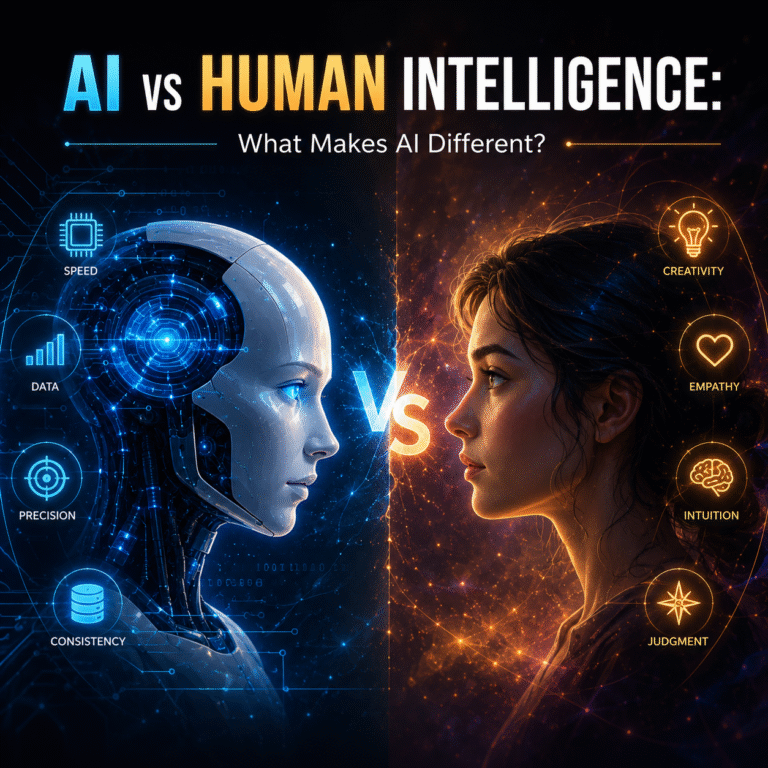
Human intelligence is not just about problem solving or information gather. Rather it includes emotions, creativity, self-awareness, and moral reasoning. It has an ability to adapt to complete new situations. Humans learn from data but also experiences, relationships and institution matter a lot.
Artificial intelligence on the other hand is mainly designed to perform tasks required like human thinking. It includes pattern, making predictions, understanding language, and generate outputs. But AI does not understand the same like humans. It processes inputs and produces outputs.
That distinction shapes everything that follows.
How AI Thinks vs How Humans Think
The major difference between them is based on the decisions made.
AI systems rely only on data. It includes more data and better way to perform. AI trained lacks of images to learn to detect disease with high accuracy. But it does not identify the patterns and the way doctor tells exactly to the points.
Humans, in contrast, don’t need massive datasets. A person can learn from a single experience, draw conclusions, and apply them to new situations. Of course, it has an ability to identify and generalize the struggles faced today.
Reasoning is another difference. Humans can think abstractly and imagine possibilities and operate ethically. But AI follows logic definitions by algorithms. It does not question its purpose and tell the proper solution.
Learning: Experience vs Data
Based on the life experience, humans can learn a lot and gain knowledge. It has steady observations and overcomes trial as well as error. Emotions play an important role in learning and motivation shape what to learn and how to learn.
On the other hand, AI learns differently and trained using datasets and labelled and structured. Machine learning models make the process internally strong based on the errors. Over time, they become more accurate and scope of training is required.
Creativity: Original or generated?
AI generated art, music, and writing have sparked debate recently. Will you ask can machines be creative? Let’s break it out.
AI can produce impressive creative outputs. It can write poems, and compose music and design visuals. They can able to identify strong results and combine patterns from existing date. They carry out personal experiences, emotions, and creations.
Humans’ creativity is depended on personal and comes from emotional, memories, and culture. When a person creates something between imagination, it reflects their unique perspective.
Emotions and Consciousness
Humans feel emotions, sadness, empathy, anger, and relationships. Emotional intelligence permits us to connect, communicate, and understand deeper level. AI does not feel anything and it is completely a machine language. They can be programmed to recognize emotional cues or responds to appear in experience emotions. There is behind its actions and AI lacks the awareness with fundamental limitation.
Speed and Efficiency
If there is AI clearly outperforms than human, we can say its speed. AI can process massive amount of data in seconds. It can analyse trends, detect anomalies and perform calculations. It makes the incredible approach and fields with finance, healthcare and logistics. Humans can however get into incomplete information and needs more time than AI. In many real-world scenarios, combing human insights with AI efficiency tools may leads to the best results.
Accuracy vs Judgment
AI is mainly praised for its accuracy, and depends on the data it receives. If the data is biased or incomplete, then results will reflect the flaws.
Humans are not perfect in all ways and all the time. They have biases, and sometimes, rely on intuition over logic. However, humans can recognize and question their own biases. We can able to reflect, learn and change ourselves.
But AI cannot do than on its own.
Are Humans at Risk of Being Replaced?
Many people worry about this question and still IT field is shattering.
AI is already automating repetitive and data heavy tasks. They can surely overcome human tasks and doing its job perfectly. It is perfectly changing how it is doing. Replacing human intelligence entirely far more complex makes the creativity, emotional intelligence, and critical thinking.
Human interaction is much harder to automation. Instead of replacing humans, AI is more likely to augment our ability and responsibilities.
The Future: Collaboration, Not Competition
We cannot separate or avoid any one of these AI vs Humans and compare. Let us say, it is like AI with humans.
AI can handle large scale data processing. But humans provide context, creativity, and ethical judgement. Together, they can solve problems more effectively than either alone.
For example:
- In healthcare, AI can perform well and doctors diagnose the disease faster.
- In education, AI can monogram learning, though teachers provide control and support.
- In business, AI can examine trends, although humans make tactical decisions.
The main goal is not to replace intelligence but it has to enhance the performance.
The Bottom Line
AI and human intelligence may appear similar on the go. But they have fundamental difference.
AI is fast, data drive, and highly efficiency. But it has its own limitations for programming and training. Human intelligence is mainly slower than far more complex. They can shape, by emotions, experiences, and consciousness.
AI can mimic thinking and does not truly understand. It can generate ideas and does not have feelings and emotional. It can assist directions and no responsibility is guaranteed.
People can ask question which is better? But the solution is how can use AI to complement what makes us uniquely human?
You can Also go through our other Blogs