


AI vs Cybersecurity: Which Is the Best Career Choice in 2026?
Every few years, people in tech start wondering, “What career should I choose for the future?” In 2026, many are asking, “Should I go into artificial intelligence or cybersecurity?”
Both fields pay well and are growing faster than most other areas in tech. They differ in daily tasks, required skills, and future job trends. If you are deciding between them, this post is for you.
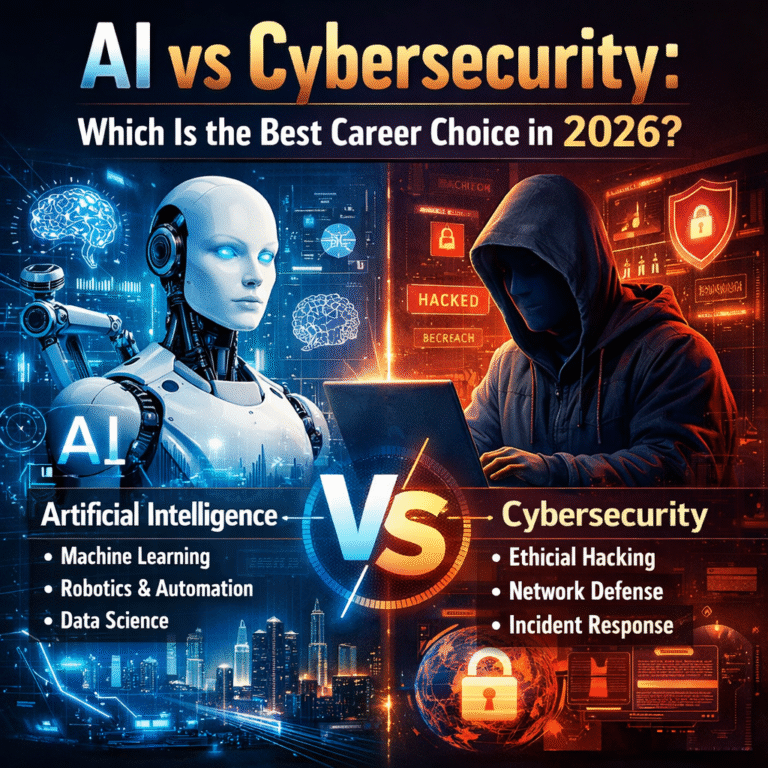
First: What Do These Fields Even Mean?
Artificial intelligence is the science of creating machines and software that can think, learn, and make decisions. An AI expert might build a machine learning model to identify diseases in X-rays, create a recommendation system for a streaming service, or fine-tune a large language model for a company. It’s the intersection of math, data, and coding.
Cybersecurity, on the other hand, is the art and science of protecting digital systems, networks, and information from attack. A cybersecurity expert could be hunting for vulnerabilities in a company’s software, dealing with a live breach of their data, creating secure cloud environments for a company, or developing automated tools to catch attacks. It’s the intersection of strategy, analysis, and defense.
Different problems. Different mindsets. Both are needed.
The Numbers: How Big Are These Fields Right Now?
Let’s start with some real data, because the numbers here are genuinely impressive.
The AI market is expected to reach $1.3 trillion by 2029, according to Forbes Business Insights. Meanwhile, the cybersecurity market is projected to hit $345 billion by 2026. These are not small numbers. Both industries are experiencing explosive growth, and the demand for skilled professionals in both areas is rising faster than educational institutions can keep up with.
According to research, job postings seeking AI skills increased by 81%, and those seeking cybersecurity skills increased by 33% between 2024 and 2025. That tells you something important: AI hiring is accelerating at a much faster rate right now, but cybersecurity demand is still growing very strongly.
On the cybersecurity side, there are currently around 3.4 million cybersecurity jobs available globally, and the industry has reached near-zero unemployment on multiple occasions in recent years. The cloud and IT services sector is entering 2026 as the most aggressive recruiter of cybersecurity talent, with companies prioritizing roles in cloud security engineering, identity and access management, and DevSecOps.
Salaries: Who Earns More?
Well, this is normally the first question people want to know. So let’s get straight to it!
Generally, AI pays more, especially at senior levels. Average salaries for AI engineers and specialists are among the highest in tech, and demand is surging.
The cybersecurity field also pays very well. However, the curve is a bit different. In the cybersecurity field, professionals in the USA can expect an average salary of $124,452 annually. Entry-level positions start at $96,490 annually, and senior-level professionals can earn $170,000 annually. The reason it matters is that cybersecurity offers more entry-level opportunities compared to AI. However, AI offers a much higher salary if you are able to build expertise in the field.
Job Security: Which Field Is Safer to Be In?
Both fields are genuinely recession-resistant, but for different reasons.
Cybersecurity has a built-in guarantee: cyber threats are not going away. By 2026, analysts predict global cybercrime costs could reach trillions of dollars annually. As businesses increasingly rely on cloud ecosystems, AI-driven operations, and hyper-connected devices, the attack surface expands faster than companies can secure it. You literally cannot outsource the need for security. Every business that goes digital needs protection.
AI, on the other hand, is becoming the engine of every industry. By 2030, AI could contribute up to $15.7 trillion to the global economy, which is more than China and India’s combined output today. Every sector, from healthcare to manufacturing to finance, is hiring people who can build and deploy AI systems.
Here is something interesting: AI is not replacing cybersecurity experts; it is amplifying their productivity and increasing the need for advanced human judgment. AI is reshaping cybersecurity from reactive defense to predictive security. The two fields are increasingly connected.
What Skills Do You Actually Need?
And that’s where these two paths start to feel really different.
In AI, you need a solid foundation in math, stats, and programming. Python is a non-negotiable. You also need to get comfortable with machine learning libraries such as PyTorch or TensorFlow; know how to work with large datasets; and have a specialty, whether computer vision, natural language processing, or generative AI. And over 75% of AI job postings require domain experts with deep knowledge in a specific area; generalists need not apply.
In cybersecurity, the skill set is much broader and more diverse.
In cybersecurity, you are supposed to have a solid foundation in network security, vulnerability assessment, incident response, threat intelligence, risk management, and cryptography. Critical thinking and decision-making are equally important alongside your knowledge of these concepts.
One of the biggest differences is that AI requires much deeper academic preparation.
In cybersecurity, there are many more entry points for those who want to get started. Certifications and hands-on labs are a big part of it.
Which One Should You Choose?
The honest answer is there is no right answer, but here are some interesting ways to think about it.
Choose AI if:
- You enjoy math, data, and building intelligent systems.
- You’re willing to invest the time to navigate a steep initial learning curve.
- You want the potential for the highest salary ceiling.
- You’re interested in building new technology, not just protecting existing ones.
Choose Cybersecurity if:
- You enjoy problem-solving and thinking like a detective.
- You want to get started quickly in a high-paying field without necessarily needing a graduate degree.
- You’re interested in protecting people and organizations from real-world threats.
- You enjoy the variety of roles in cybersecurity, from ethical hacking to compliance to cloud security.
Here’s one more interesting piece of information to consider. While you might think you have to choose one or the other, the truth is you can actually learn both AI and cybersecurity. In fact, more than 60% of security operations centers worldwide have already begun employing AI-based tools. Individuals who possess expertise in both AI and cybersecurity are highly valued and in high demand.
The Bottom Line
Both AI and cybersecurity are excellent career choices in 2026. Neither field is going away, neither field is being made obsolete, and neither field will ever stop growing for at least the next ten years.
If you desire increased earning potential and enjoy designing intelligent systems from the ground up, AI is the way to go. If you desire job security now, numerous entry points, and the satisfaction of fighting against genuine threats, cybersecurity is an excellent choice. And if you can do both well, even better!
The most important step you can take right now isn’t choosing which of these two fields is the “better” one. The most important step you can take right now is to ask yourself which field you have a genuine interest in. The people who delve the deepest into their field of choice and stay up-to-date are the ones who will ultimately win, regardless of the circumstances.
You can Also go through our other Blogs